

On January 28, 2026, a joint launch event themed “2026 NEXT : New Horizons | Cockpit Payment Agents and a New Mobility Paradigm” took place at the Moli Community in Zhangjiang, Pudong, Shanghai. JDO, Zhipu, and China UnionPay jointly unveiled a cockpit-native payment agent. Designed around intelligent cockpit use cases, the product restructures payment capabilities at the system level, offering a new technical approach and application model for the intelligent vehicle service ecosystem.
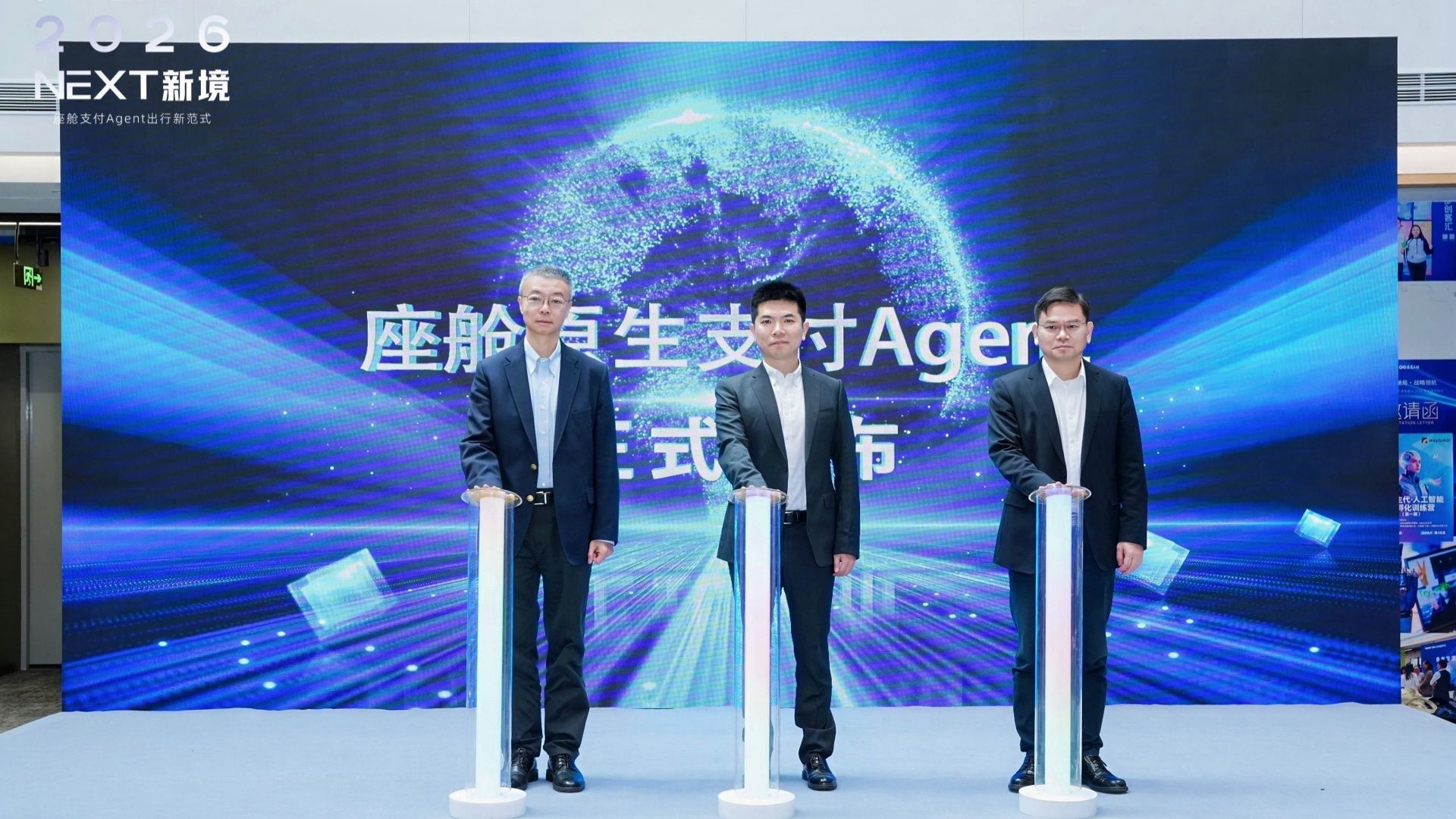
The newly launched cockpit-native payment agent goes beyond the simple integration of traditional payment functions. Led by JDO and built on its independently developed cockpit agent architecture, it treats payment capabilities as a native part of the cockpit service process. By understanding user intent, vehicle status, and mobility context together, the product coordinates service initiation, decision execution, and payment completion within the cockpit system, allowing payment to become a natural part of the travel experience.
Technically, the cockpit-native payment agent uses a layered architecture of “foundation model + context-specific agents.” Zhipu provides the GLM large model as the foundation, giving the system stable, general-purpose cognitive and reasoning capabilities that can continue to evolve. On this foundation, JDO builds agent capabilities for in-vehicle use cases, enabling controlled execution of cockpit services and payment processes.
As one of China's leading large model developers, Zhipu has long focused on artificial general intelligence and multimodal large models. Its GLM (General Language Model) series offers mature capabilities in language understanding, contextual reasoning, and multimodal semantic alignment, and has been deployed at scale across multiple industries. In this partnership, the GLM large model provides a unified foundation for semantic understanding and reasoning for the cockpit payment agent, enabling the system to understand natural-language instructions, open-ended intent, and contextual relationships in complex, ongoing mobility situations.
In vehicles, users often give incomplete instructions, rely heavily on context, and face rapidly changing situations. GLM's capabilities in long-context understanding and multi-turn reasoning help the cockpit system maintain semantic consistency across ongoing conversations and dynamic contexts. This provides stable input for higher-level agent decisions and execution, supporting the cockpit payment agent's continuous operation.
Building on the GLM foundation model, JDO draws on more than 10 years of engineering experience in intelligent cockpits to develop an agent capability system for in-vehicle environments. Key modules include intent interpretation, task decomposition, service orchestration, and execution control, translating large model capabilities into deployable, production-ready system capabilities under constraints of limited in-vehicle computing resources, high real-time performance requirements, and strict safety standards. Drawing on practical experience serving more than 30 automakers in China and overseas and covering over 40 million production vehicles, the cockpit-native payment agent can flexibly support different cockpit platforms and system architectures, reducing the complexity of feature integration and system deployment for automakers.
For payment capabilities, China UnionPay provides its MCP (Model Context Protocol) payment service, which supports invocation by large models. This service enables the cockpit-native payment agent to connect to multiple payment use cases and services while meeting financial regulatory and security requirements. Through standardized integration with cockpit service processes, UnionPay payment capabilities can be invoked smoothly in common mobility use cases such as refueling, parking, and in-vehicle entertainment, providing reliable infrastructure for cockpit payments and ensuring compliance with financial security and regulatory requirements.
Through the three parties' collaboration, the cockpit-native payment agent can now operate reliably across multiple frequent mobility use cases. Combining journey information and user actions, the system connects service initiation and payment execution in a continuous process. While maintaining safety and control, it significantly reduces the actions users need to take when paying inside the vehicle and improves the continuity of the overall travel experience.
JDO CEO Wang Yifei said that the cockpit-native payment agent is one of the important practical outcomes under the “2026 NEXT: New Horizons” theme. Its development benefited from the Moli Community's ecosystem support and collaboration among multiple partners at different technical levels. Computing resources provided by PPIO also offered strong support for the stable operation and continuous iteration of cockpit agent capabilities. Zhipu Vice President Wen Jianhui said that Zhipu's proprietary GLM large model technologies provide the cockpit-native payment agent with core multimodal interaction and context-specific task execution capabilities. The close collaboration with JDO and China UnionPay represents a practical example of integrating large models with in-vehicle use cases and the payment ecosystem. Zhangjiang's Moli Community, with its concentration of industry participants, has also enabled efficient coordination of technologies and resources. Looking ahead, JDO will continue improving its cockpit agent capabilities and work with Zhipu, China UnionPay, and more ecosystem partners to expand product deployment across more vehicle models at scale. It will further extend into in-vehicle entertainment, health, everyday purchases, and other use cases, while exploring collaboration with leading ecosystem companies in the Moli Community, such as Dingdong Maicai, around frequent daily needs, accelerating the cockpit's evolution into an “integrated platform for mobility and everyday services.”
Industry observers see the launch as a collaborative exploration connecting large model technology, cockpit systems engineering, and payment infrastructure. It offers a new practical path toward end-to-end service delivery in intelligent connected vehicles and a valuable reference for the industry's exploration of the future of intelligent cockpits.